
Imperfect Reflections: Artificial Intelligence Debuts at the MoAa in Florence
Visual hallucinations, digital glitches, and synthetic memories: the Museum of Artificial Art opens on November 14 in Florence with an exhibition featuring twelve international artists.
Glitch is a curious word. Conceptually, it can be translated as “malfunction” or “anomaly”. The most important aspect, however, is its transience: a glitch is an error that manifests itself and then disappears – autonomously – without compromising the overall architecture of the system in which it occurs. It is a ripple, a momentary variation that reveals, at least for an instant, the hidden structure of what generated it.
The term has a long history. It originated almost a hundred years ago in the language of electronics and engineering: it refers to those small signal irregularities that disturb a transmission but do not interrupt it. Technically, we are talking about an “aperiodic transient”, a brief and sudden peak in a waveform caused, precisely, by an error. Put like that, it would seem to be something only understandable to those who are familiar with applied mathematics. But the glitch is first and foremost an idea. And as such, it transforms, changes skin, evolves, until it spans the entire history of the media.
Transient malfunctions affect all technological architectures: with the advent of information technology and video games, glitches have become a visible experience. A fragment of chaos in the orderly flow of the machine, the software, the console. A video game character sinking into the floor, a distorted image, a line of dialogue repeating itself endlessly: these are the moments when the code reveals itself, when the system shows its vulnerability. Virtual reality – which until recently found its highest expression in the world of video games – betrays its nature as a “simulation”, distorting itself for a few seconds.
 Joy Fennell, The Stillness Was an Act series I, 2024
It's déjà vu from The Matrix, so to speak. I mention a film (and what a film!) on purpose. The Matrix works like a Rorschach test: philosophers, sociologists, psychologists and media theorists have produced hundreds of interpretations of the film's true meaning, transforming it into a mirror in which to reflect our culture. Well, with the necessary proportions, glitches work in a very similar way: technologies embody our values, our desires and, above all, our fears.
Today, in the age of artificial intelligence, glitches have become “hallucinations”. The term, evoking a perceptual error, captures a crucial aspect: generative AI imitates us more than we think. When a system creates an inconsistent image, when it “remembers” incorrectly, when it invents facts and information to satisfy a prompt it cannot respond to, it is showing the fallible logic of our own thinking. AI hallucinations are nothing more than cognitive glitches, reflections of the noise that also inhabits the human mind. If a computer glitch is an error that reveals the code, a psychological glitch is an error that reveals a short circuit in memory. After all, our consciousness is also a tremendously complex system. And as such, it is subject to interference. We convince ourselves that we remember things that never happened, that we have seen things that do not exist. Are you familiar with the Mandela effect, the phenomenon in which a group of people share a false memory? Well, we could see it as a glitch of the unconscious, like an echo of corrupted data. It is no coincidence that we are talking about an idea that originated and grew on the internet: if you don't know the story, I'll summarise it in a few lines.
It all began in 2009. Writer and researcher Fiona Broome attended a conference on the paranormal. Talking to the audience, she discovered that many people, like her, clearly remembered Nelson Mandela dying in prison in the 1980s. Everyone present shared the same vivid memory of his funeral being broadcast on television. Of course, Mandela was actually alive and well. In fact, in 1994, he had even become president of South Africa. So, struck by the fact that so many individuals – with no apparent connection – shared the same false memory, Broome opened a forum (mandelaeffect.com) to collect other examples of incorrect collective memories. Within a few months, the site went viral. Reports multiplied, and with them the most absurd explanations for the phenomenon.
According to some (pseudo)scientists, false memories are proof of the existence of parallel universes; the tangible manifestation of countless alternative realities; or, even, overlapping quantum states that intertwine in the collective consciousness. By amplifying theories bordering on conspiracy theories, the web has become the perfect stage for a digital meta-narrative: for those who navigate the abyss of the internet, the Mandela Effect would unequivocally prove that we live in a simulation. According to them, we are avatars immersed in a virtual machine. Characters who are unaware that they are part of a code: sentient beings who, through false memories, can find clues to the reprogramming of their brains. A glitch, in short. A glitch within a glitch.
 VIXY, No Signal, 2023
However, on closer inspection, the relationship between machines and humanity has always been – how can we put it? – “symbiotic”. The spectre of Artificial Intelligence, now more than ever, is exacerbating an idea that we have been harbouring, at least unconsciously, for centuries. There is a wonderful book (Being a Machine by Mark O'Connell) that traces our long technological honeymoon. In his essay, the author demonstrates that in every historical era we have sought to represent the human body and mind through the dominant technology. In ancient Greece, the theory of humours followed the doctrine of pneuma: for Hippocrates, the body functioned according to hydraulic principles. In the Renaissance, bones and organs were studied as clockwork mechanisms; in the Industrial Revolution, on the other hand, as steam engines – it was from this image that Freud derived the concept of the unconscious.
Finally, with the digital revolution, the human brain has been imagined, represented and studied as a computer. And vice versa. This is a useful but insidious analogy. Useful, because it has allowed cognitive science to model thinking as a process of information processing. Insidious – not to say dangerous – because it tends to reduce the mind to a predictable system of input and output, erasing everything in us that is not rational: intuition, error, desire. Yet it is in imperfection, in mutual anomalies, that we can find the most authentic similarity between ourselves and the machines we are building. The glitch, translated into aesthetic language, is a wound that reveals the structure. Where the image is corrupted, the reality of the system is revealed. And if this is true for machines, the same concept applies to the intimacy (and fragility, I would add) of the human creative act.
The art of AI, in its infinite possible forms, marks today the transition from a culture of representation to a culture of generation. Tools are no longer mediators, but co-authors: this is the meaning of the exhibition 'My Memories. Dreams, Hallucinations and Memories of Artificial Intelligence', the inaugural event of the MoAa (Museum of Artificial Art) in Florence, a new space created with the ambitious mission of positioning AI-created art within the world of contemporary art.
On 14 November 2025, overwriting the birthplace of the Renaissance with the emerging contemporary cultural renaissance, the porous boundaries between human memory and artificial imagination will be explored: the event brings together twelve cutting-edge international AI artists, called upon to address the problems and opportunities of a collective memory contaminated – perhaps, who knows, even optimised – by the rise of Artificial Intelligence in our daily lives.
 Dullia, RITUALL, 2025
Each artist has a unique language, derived from the unsettling contamination between analogical thinking and algorithmic calculation. Joy Fennell and Dai, in particular, rework the tradition of classical portraiture and fashion photography, introducing the face and presence of black subjects into a historically Eurocentric imagery. Their works do not use artificial intelligence to create ideal worlds, but to correct cultural repression. Mindeye's images, on the other hand, are generated from prompts that describe feelings: the AI interprets and produces images that occupy an ambiguous, disturbing space.
Maddy Minnis, Laura Buechner and Vixy work on the very substance of the image: organic textures, plant fibres and digital epidermis merge into a hybrid ecosystem. In Circus of Artifice's work, the machine truly dreams: mythological characters, festive scenes, rituals and visions blend together in a chromatic delirium that seems to emerge from a digital unconscious. Dullia.K, with its sequences of movement and colour, constructs a choreography without a choreographer. The figures dance, but the rhythm does not obey a will: it is the result of a self-organising system. Parallel.fbx chooses to shift the dialogue to the level of collective memory and territory. His works take as their starting point images of southern Italy, filtered through the distorted and stereotypical lens of the global digital imagination.
 Infrarouge, Untitled, 2025
Infrarouge explores the contemporary surface of visual culture: streetwear, sci-fi aesthetics, post-human architecture. His figures seem to come from an alternative, fragmented and hyperconnected timeline, where bodies become data and subjectivity is lost in the endless feed of doom scrolling. Finally, Melita Radocaj (Ctrl_cd) synthesises the contemporary human condition in multiple figures: men and women with overlapping faces, layered bodies, dressed one on top of the other like open files in memory. Her work is a metaphor for our fragmented identity, multiplied by constant interaction with algorithms.
So, "rewriting" our own memories. Is this the risk we run today? Is this the glitch, the unprecedented short circuit of the largest memory machine ever built – the Internet – which is at the same time the place where reality bends to manipulation?
Perhaps. What is certain is that every day billions of images, texts and fragments of reality are copied, recombined and distorted on the web. The error creeps in, spreads, and finally stabilises as a new shared truth. We live in an extension of reality that produces more information than we can ever analyse. And when the overload becomes unsustainable, we invent connections and fill in the gaps. We too have our glitches, of course, which preserve the architecture of the system: we do it to survive, to give continuity to meaning. Every Mandela Effect, after all, is an attempt to repair a fracture in the collective narrative.
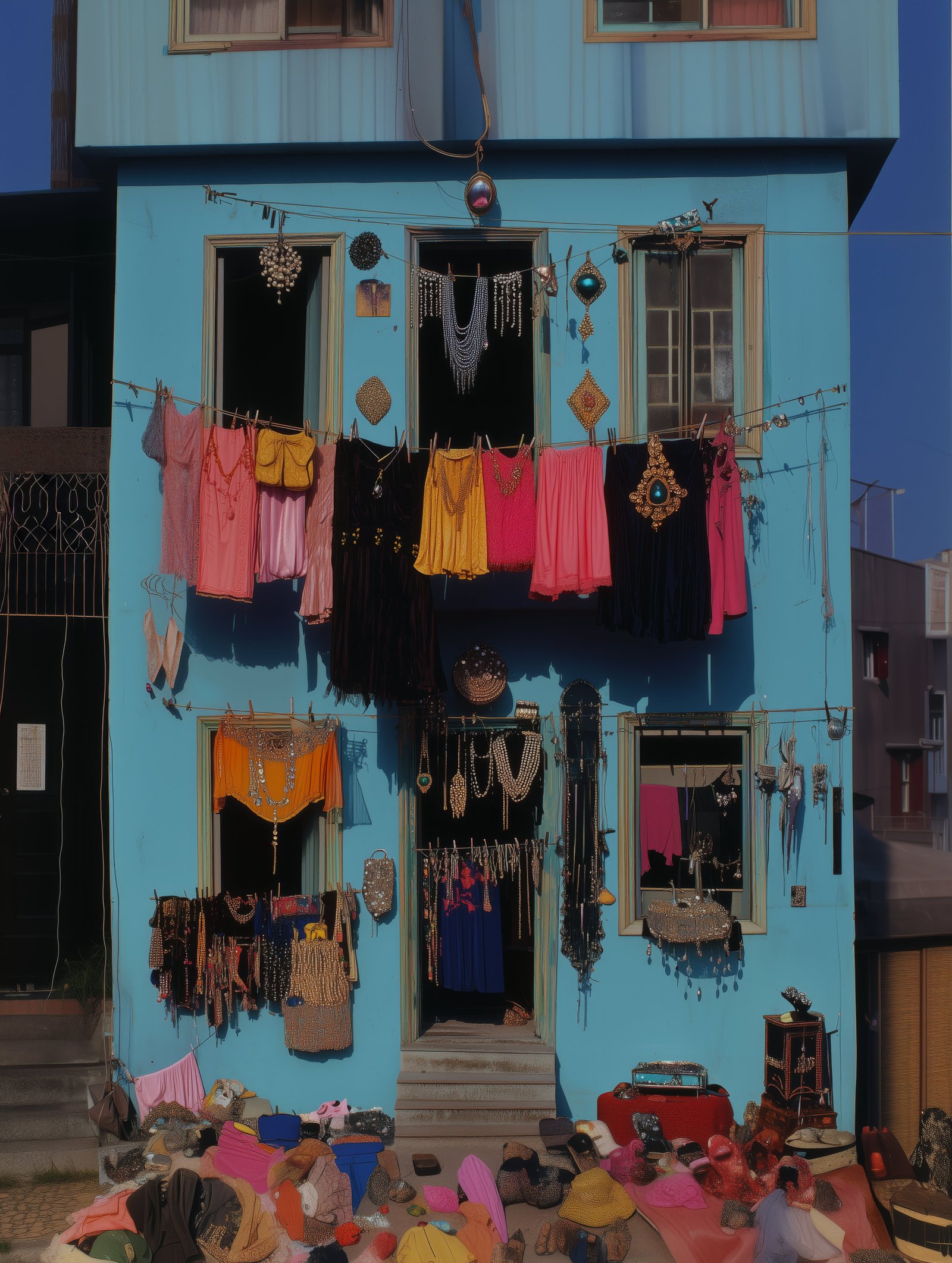 Parallel.fbx, The Façade, 2025
Art generated with artificial intelligence moves in the same territory. The works of MoAa do not merely represent this process: they embody it. Their worlds are memories of something that never happened, but that we could swear we experienced. Images that seem to come from a possible past, or from a future just dreamed.
In their digital plots, reality and hallucination merge until they become indistinguishable – not because AI wants to deceive us, but because it reflects the way our own consciousness works. After all, remembering is a creative act. Every time we evoke an event, we reconstruct it; every time we recount it, we transform it. Memory, like a generative algorithm, does not preserve: it regenerates. We are part of a process that updates, confuses and expands itself – like a dream that never stops being dreamt. Perhaps we really do live in a simulation. Well, if that were the case, art would be the most sincere, exciting and intriguing way to glimpse reality, the “real” one.
Cover image: Maddy Minnis, Trail Cam, 2023
Creative, teacher and expert in visual culture, Alessandro Carnevale has worked on TV for several years and has exhibited his works all over the world. In 2020, the Business School of Il Sole 24 Ore included him among the five best Italian content creators in the artistic field: on social media he deals with cultural dissemination, covering a wide spectrum of disciplines, including the psychology of perception, semiotics visual, aesthetic philosophy and contemporary art. He has collaborated with various newspapers, published essays and written a series of graphic novels together with the theoretical physicist Davide De Biasio; he is the artistic director of an open-air museum. Today, as a consultant, he works in the world of communication, training and education.


